Last updated: 2026-09-24
Creating a testing setup
Each template has a hidden reference project as the test base, which can be opened from the Testing tab or the Builder Config tab. This project can be configured in one or more variants to download all variants at once in a zip archive. This allows to download and test all your custom extensions.
It is recommended to unpack this zip in an internal pipeline (e.g. in GitLab) and build all contained projects. This ensures that after code or version updates the current code state is executable and new projects start without errors.
This is the validation step in the Enterprise template workflow: configure the template, test the generated variants, and then use the automatic Git export to bring updates to existing projects.
An example script could look like the following. Your pipeline could send an error email in case any build has failed.
Testing properties
By creating testing properties, additional versions of the reference project can be added to the zip file. Each group defines an additional version of the project to which all test properties of this group are applied. The group name is used as a project suffix.
We recommend to start with a fully configured project that enables as many relevant options as possible. Then add one to three variants with different or fewer options. This helps verify both the complete setup and the combinations your teams are likely to use.
Each property references a field (including custom options) and a value assigned to it. When the custom options are changed, the test properties are also updated, but these settings should be reviewed afterwards to make sure the setup isn't outdated.
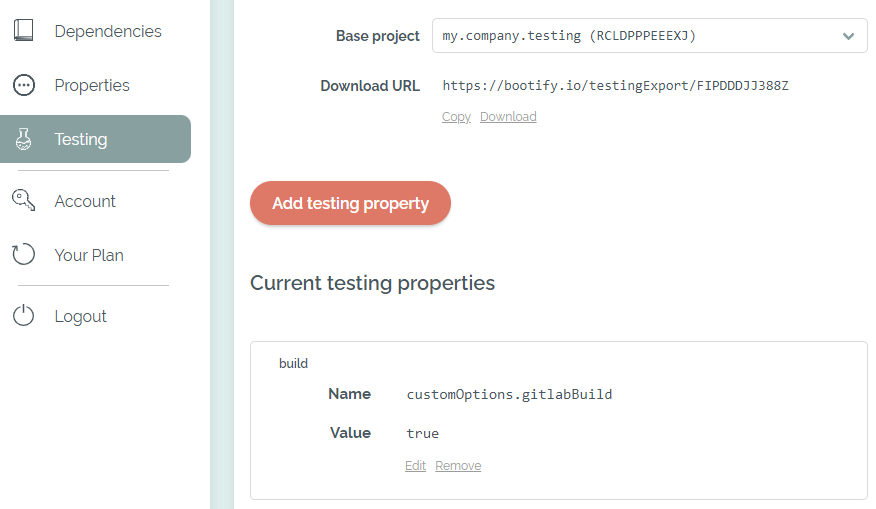
Defining further variants of the test base